When a thing is wick, it has a life about it.
Now, maybe not a life like you and me.
But somewhere there's a single streak of green inside it.
Come, and let me show you what I mean.
--from The Secret Garden (lyrics by Marsha Norman)
A week after planting my strawberries in starter pots (and plastic cups) I found myself looking for signs of life. The ones I planted in the cups (first batch) mostly had green leaves when I planted them. The ones I put in the bio-degradable pots (second batch) with Miracle-Gro potting soil, on the other hand, were an exercise in hope. They looked pretty far gone. And after a week, there were no signs of life in them.
The ones in the plastic cups, on the other hand, had changed dramatically. They had seemingly died.
I attributed that to the soil and to the container, which didn't let air in or water out. I went through them carefully looking for any signs of life-a live leaf, a shoot of green, even some fuzz that didn't seem to be too brown. Those that offered hope I transplanted into the bio-degradable pots with the Miracle-Gro, replacing the plants that clearly were beyond saving. I tried to shake off all the inferior soil and replant them carefully to give them the best chance of life.
In the end, I trashed all the second batch (put them in the compost, actually) and re-potted all the first batch, even though some of them showed little or no sign of life. Eight of them looked to survive, while the rest were again an exercise in hope.
Each day I checked them, watered them if needed, and looked for that single streak of green. Now after a week four or five more are wick, and I'm giving the others a chance to prove themselves. I eagerly look forward to checking them every day, amazed at the miracle of life within them, astounded that they have come back from seeming death.
It's kind of that way with people. Now and then I run into people who seem to be zombies-the living dead. They have a pulse, they hold down a job, they even smile from time to time. But the signs of life are weak. Perhaps they've been beaten into submission by the circumstances of their lives or by others around them who have slowly-or even all at once-drained the life out of them. Perhaps they've made destructive choices, betrayed the divinity within them.
What they don't seem to have is purpose, direction, hope, faith.
And yet, if you look closely enough, over a period of time, nurturing and caring for them with friendly interactions and supportive words and deeds, you may just catch a fleeting glimpse of green inside and realize that they are wick after all.
When a thing is wick, it has a light around it.
Maybe not a light that you can see.
But hiding down below a spark's asleep inside it,
Waiting for the right time to be seen.
If you care to, and if they permit you, you can help clear away the dead things and nurse them back to life. It isn't always easy, and not every one revives, but when they do, it's one of the most rewarding experiences I've ever had.
When we engage in that kind of gardening, we are doing God's work, and He can provide a joy that passes understanding. If we are wick with that light, we may gain Eternal Life.
Friday, May 14, 2010

Thursday, May 6, 2010
Berry Late
I finally got my strawberries planted. Well, at least in starter pots. I ordered the berries from a mail order nursery, because the write-ups in the online catalog made these varieties seem much better than those available at local stores. And the price was appealing.
We had strawberries in Utah, when we lived there, but they were a small variety, and not very firm. They produced plentifully, but the children tended to eat them as soon as they were ripe. And really, they didn't keep well anyway. I wanted better this time. So I ordered two varieties that are supposed to be large and meaty, but tasty. One is an early bearer and the other is supposed to produce throughout the summer.
When the shipment arrived, I was surprised to find that I had two plastic bags of roots. Before I placed the order, I called their customer service line to ask how they would come, but nothing prepared me for what I received. In each bag appeared to be a bundle of brown tendrils bound together with a rubber band. I began to second guess my decision to order them, especially since right afterwards I began to see large strawberry plants available at the local nurseries and box stores, some of them with blossoms on them already.
 Even then, I didn't plant them. I was still waiting on retaining wall block for my last planting box (all the block seems to be back-ordered around here). I left the roots in the bags, thinking I would plant them very soon. After about a week, I noticed that they began to grow leaves inside the bag, and the moisture was condensing on the inside of the bag, so I thought they would be alright. And still I didn't get the planting box finished. (It didn't help that we had about a week of rain.)
Then I noticed one day that the leaves were gone, and I worried that I had let my strawberry roots die. So at my first opportunity, I got some plastic cups, put some soil in them, and planted one bag of the roots in them. Since I ran out of cups, I had to go to the store, and there I found some biodegradable starter pots, which I purchased for the other bag of roots. I also remembered reading that you shouldn't plant strawberries where you've previously had tomatoes or peppers, because they cause the soil to rot the strawberry roots. The soil I had used came from the box where I had tomatoes last year, so I bought some potting soil and planted the second batch in that.
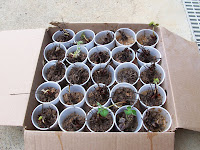 Now my planting box is still not ready, and the plants don't seem to be doing well. The second batch don't appear to have any life left in them at all, and the first batch I'll have to replant in proper starter pots with potting soil. A few of them have green leaves, but I think I may have killed 45 of the 50 plants.
It didn't ease my pain to finally find the instructions of how to care for them if I wasn't going to plant them immediately. I had looked for something like that when I received the box, but didn't find it at the time. Now I found it, and learned that I should have opened the bag and poured water in every other day.
Really, I should have just planted them in the starter pots from the beginning. It seems pretty late in the season now, and I may have missed my window of opportunity for this year.
As a curious aside, while I was sitting on the driveway planting them, with my youngest two children playing nearby and helping me, two Jehovah's Witness women came by and struck up a conversation with me. I was not interested in their message, but in general I do admire their fervor and commitment in that faith. So I talked with them while I sat there and continued working. I took the opportunity to share my faith and testimony with them, and though neither convinced the other, I think we were all enriched by the encounter. The most important part for me was to demonstrate for my children respect for others and testifying of the truths I know when the opportunity arises.
After all, it's not only fruits and vegetables I'm trying to raise well.
We had strawberries in Utah, when we lived there, but they were a small variety, and not very firm. They produced plentifully, but the children tended to eat them as soon as they were ripe. And really, they didn't keep well anyway. I wanted better this time. So I ordered two varieties that are supposed to be large and meaty, but tasty. One is an early bearer and the other is supposed to produce throughout the summer.
When the shipment arrived, I was surprised to find that I had two plastic bags of roots. Before I placed the order, I called their customer service line to ask how they would come, but nothing prepared me for what I received. In each bag appeared to be a bundle of brown tendrils bound together with a rubber band. I began to second guess my decision to order them, especially since right afterwards I began to see large strawberry plants available at the local nurseries and box stores, some of them with blossoms on them already.

Then I noticed one day that the leaves were gone, and I worried that I had let my strawberry roots die. So at my first opportunity, I got some plastic cups, put some soil in them, and planted one bag of the roots in them. Since I ran out of cups, I had to go to the store, and there I found some biodegradable starter pots, which I purchased for the other bag of roots. I also remembered reading that you shouldn't plant strawberries where you've previously had tomatoes or peppers, because they cause the soil to rot the strawberry roots. The soil I had used came from the box where I had tomatoes last year, so I bought some potting soil and planted the second batch in that.
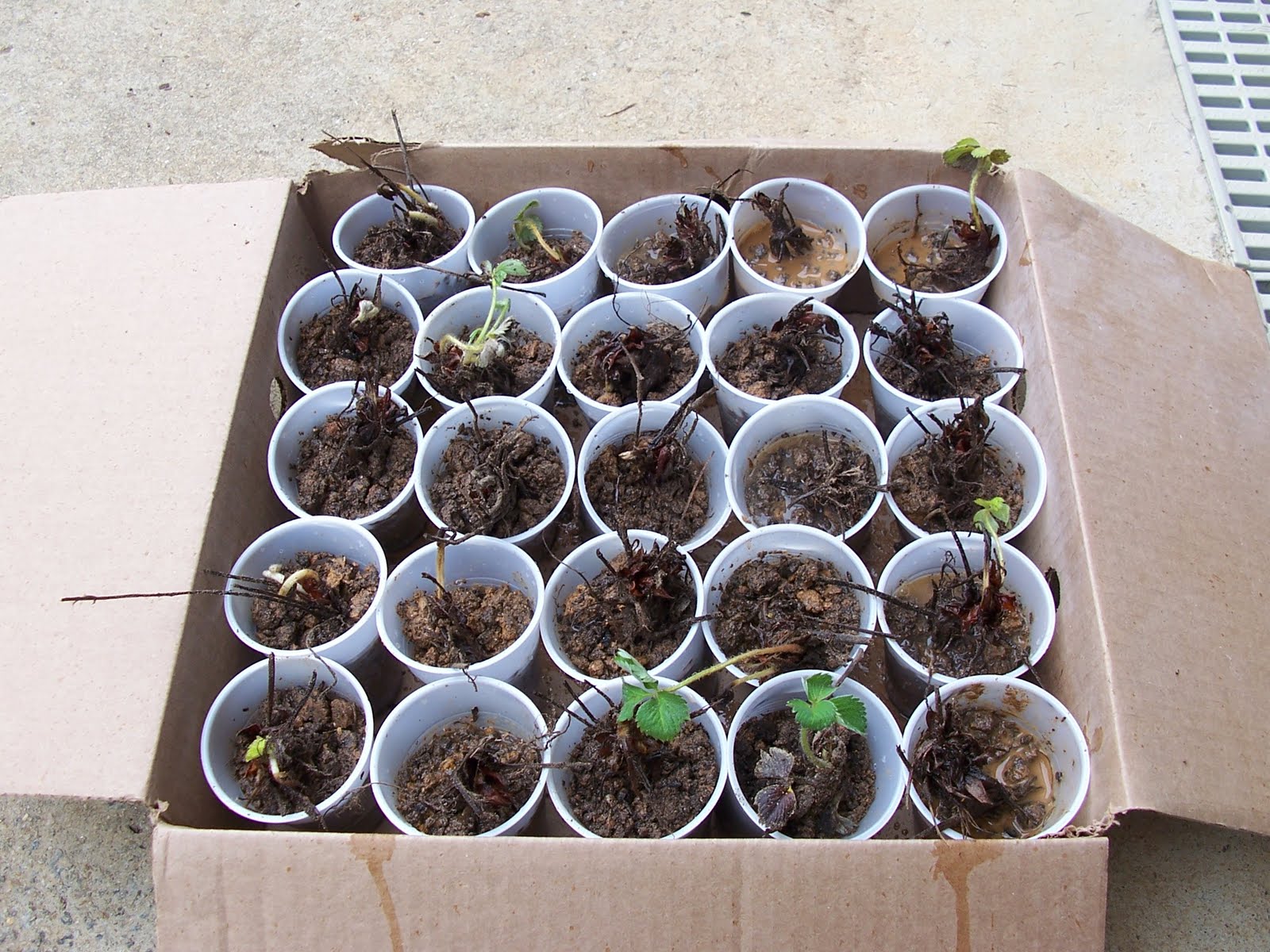
It didn't ease my pain to finally find the instructions of how to care for them if I wasn't going to plant them immediately. I had looked for something like that when I received the box, but didn't find it at the time. Now I found it, and learned that I should have opened the bag and poured water in every other day.
Really, I should have just planted them in the starter pots from the beginning. It seems pretty late in the season now, and I may have missed my window of opportunity for this year.
As a curious aside, while I was sitting on the driveway planting them, with my youngest two children playing nearby and helping me, two Jehovah's Witness women came by and struck up a conversation with me. I was not interested in their message, but in general I do admire their fervor and commitment in that faith. So I talked with them while I sat there and continued working. I took the opportunity to share my faith and testimony with them, and though neither convinced the other, I think we were all enriched by the encounter. The most important part for me was to demonstrate for my children respect for others and testifying of the truths I know when the opportunity arises.
After all, it's not only fruits and vegetables I'm trying to raise well.
Wednesday, May 5, 2010
Peach Schemes
When we found this house, one of the things that really appealed to me was a spacious backyard with lots of mature trees. I was also pleasantly surprised to find, tucked under the bigger trees, two peach trees. I cleared away all the brush and brambles, and cut away a few branches to give these peach trees more sunshine. Then, last spring they blossomed beautifully and I was pleased to see lots of small peaches growing. There were so many that I knew I would have to do some serious thinning, but I wanted them to get about an inch long so I could tell which ones were more viable.
One day there were bunches, and I knew I would have to get out there soon, and the next time I checked, there were only a handful of young peaches left on the trees. I thought perhaps a recent storm had blown them off, but couldn't find any on the ground. Anyhow, the thinning job was no longer necessary. The next time I came out, I discovered there were no peaches left at all on the tree. How could that be? I finally determined that it must have been the squirrels who stole them all away. I didn't think the birds had done it.
This year I was determined to get a good crop of peaches. Now, even though Georgia is the peach state, I don't know anyone here in Northern Georgia who has had any luck with their peach trees in their yards. I'm told they always lose the crop to "brown rot," whatever that is. (See how I betray my inexperience?) Thing is, I've never seen brown rot on the tree, because the peaches never lasted long enough to get it. So I figured one thing at a time, right? Protect them from the squirrels first.
 I decided to wrap the trunks in something that the squirrels couldn't climb. I checked at the big box stores, and no one was any help. Apparently people don't generally go looking there for something like this. I finally found some aluminum flashing that might work. I have now put that flashing around the trunks of the trees. On one of them I was able to put it to four feet high (the estimated jumping ability of most squirrels, from what I've read). The other branches out lower than that, so it only goes two feet high.
So far so good. I enjoy looking out at the trees and seeing my efforts manifest plainly. Only time will tell whether my efforts bear fruit (sorry; couldn't help it). I'll let you know.
One day there were bunches, and I knew I would have to get out there soon, and the next time I checked, there were only a handful of young peaches left on the trees. I thought perhaps a recent storm had blown them off, but couldn't find any on the ground. Anyhow, the thinning job was no longer necessary. The next time I came out, I discovered there were no peaches left at all on the tree. How could that be? I finally determined that it must have been the squirrels who stole them all away. I didn't think the birds had done it.
This year I was determined to get a good crop of peaches. Now, even though Georgia is the peach state, I don't know anyone here in Northern Georgia who has had any luck with their peach trees in their yards. I'm told they always lose the crop to "brown rot," whatever that is. (See how I betray my inexperience?) Thing is, I've never seen brown rot on the tree, because the peaches never lasted long enough to get it. So I figured one thing at a time, right? Protect them from the squirrels first.

So far so good. I enjoy looking out at the trees and seeing my efforts manifest plainly. Only time will tell whether my efforts bear fruit (sorry; couldn't help it). I'll let you know.
Saturday, April 10, 2010
What the Garden Teaches
If gardening teaches patience, I must be a stubborn learner. From the beginning I've been trying to jump ahead and take shortcuts.
I did it again today. At Costco I came across some tomato plants in 3-gallon buckets. And not just any young tomato plants. No, these were three feet tall, already with fruit on them and many flowers. There were three plants to a bucket, all for only $13 and change. So I got some.
Problem is, I don't have a place to plant them. Yet. The first garden box is filled with the tomatoes and peppers we bought at the Grower's Outlet last week. The second has plants already in a third of it, but the rest of the box is waiting for enough good soil. And the third planting box isn't finished yet. It still needs a retaining wall and more excavation, not to mention planting soil.
So why did I buy the them?
Because I thought how great it would be to have fresh grown tomatoes in April, instead of waiting until July. This isn't the first time I've done this. Last fall, as Lowe's was closing out the season, they put their remaining plants on sale. I bought three raspberry plants and a pecan tree (a stick, really). The raspberry plants are still in their plastic pots in the garage. They've suffered a little damage during the winter, but I watered them and stuck them out in the sun whenever I could, and they are starting to look pretty good now. The thought of having fresh raspberries this summer wouldn't let me pass on buying them long before I was ready. Now, if only I can figure out the good spot of ground for them . . .
 I did plant the pecan tree, but you can only tell it's there by the clasps holding it to the pole. Although it's four feet tall, it's only about a half inch in diameter. I'll certainly have to be patient before I get any nuts from that one, but the impatience was manifest in buying it when it was on clearance. (Maybe I'm not impatient, just cheap. Hmmm.)
I also bought blueberry bushes and two apple trees in December and gave them to the family as Christmas presents. Knowing it would be a couple of years at least before I get a pretty good crop, I had to go ahead and take the jump. I planted one of the blueberry bushes a few weeks ago, but the other is still waiting on--you guessed it, excavation and retaining wall and soil. But I've made progress.
As for the apple trees, they're flowering and looking nice. I got one Honeycrisp and one Granny Smith. I think I've identified the (third different) spot of ground for them, but I'm concerned that it's not yet a good one. It has a water drainage problem (the whole back yard does), and I read that apple trees need well-drained soil. So now I don't know what to do. I had thought to put in French drains, but now I need to think through whether the roots would damage them. And if I wait to plant them until the drains are finished, that could be the end of the summer, or maybe even middle of the winter. I told myself I would first finish the garden boxes before I do the French drains. But, hey, that could be just in time to plant the apples in their proper season!
See how my impatience perplexes me? It puts the pressure on to take action, but my inexperience leads to indecision. And even when I do make the decision, the action must still wait, because of lack of time, knowledge, or resources.
Part of the challenge is that I'm trying to plant things I want in their proper season. So even though I'm not ready, I go ahead and buy the plants because I don't want to wait a whole year for the next optimal planting season. That's why I have fifty strawberry plants (roots, really, but that's another story) in my garage waiting for that third garden box.
Another challenge I create for myself is that I'm trying to do all the yard and garden on the cheap. While the Lord has blessed us with sufficient for our needs, I don't have lots of extra money to hire landscapers and rent equipment and all that. Sometimes supplies and equipment must wait for that tiny bulge in the budget or a tax refund. In fact, I've been digging and moving dirt and rocks for a year and a half now without even a wheelbarrow.
But not anymore! I bought my first wheelbarrow today on that same trip to Costco. I'd been looking around and comparing cost and construction and found this to be a good deal at $60. It has metal rather than wooden handles, and a metal box instead of the plastic ones that seem to be popular now. It took me two hours to assemble it (go ahead, laugh), but even in the short time left that I used it tonight, I was reminded that the right tools can make all the difference.
Maybe it's not just patience I'm supposed to be learning. Maybe it's also judgment, forethought, wisdom . . .
Amazing all the life lessons you can learn digging in the dirt.
I did it again today. At Costco I came across some tomato plants in 3-gallon buckets. And not just any young tomato plants. No, these were three feet tall, already with fruit on them and many flowers. There were three plants to a bucket, all for only $13 and change. So I got some.
Problem is, I don't have a place to plant them. Yet. The first garden box is filled with the tomatoes and peppers we bought at the Grower's Outlet last week. The second has plants already in a third of it, but the rest of the box is waiting for enough good soil. And the third planting box isn't finished yet. It still needs a retaining wall and more excavation, not to mention planting soil.
So why did I buy the them?
Because I thought how great it would be to have fresh grown tomatoes in April, instead of waiting until July. This isn't the first time I've done this. Last fall, as Lowe's was closing out the season, they put their remaining plants on sale. I bought three raspberry plants and a pecan tree (a stick, really). The raspberry plants are still in their plastic pots in the garage. They've suffered a little damage during the winter, but I watered them and stuck them out in the sun whenever I could, and they are starting to look pretty good now. The thought of having fresh raspberries this summer wouldn't let me pass on buying them long before I was ready. Now, if only I can figure out the good spot of ground for them . . .
 I did plant the pecan tree, but you can only tell it's there by the clasps holding it to the pole. Although it's four feet tall, it's only about a half inch in diameter. I'll certainly have to be patient before I get any nuts from that one, but the impatience was manifest in buying it when it was on clearance. (Maybe I'm not impatient, just cheap. Hmmm.)
I also bought blueberry bushes and two apple trees in December and gave them to the family as Christmas presents. Knowing it would be a couple of years at least before I get a pretty good crop, I had to go ahead and take the jump. I planted one of the blueberry bushes a few weeks ago, but the other is still waiting on--you guessed it, excavation and retaining wall and soil. But I've made progress.
As for the apple trees, they're flowering and looking nice. I got one Honeycrisp and one Granny Smith. I think I've identified the (third different) spot of ground for them, but I'm concerned that it's not yet a good one. It has a water drainage problem (the whole back yard does), and I read that apple trees need well-drained soil. So now I don't know what to do. I had thought to put in French drains, but now I need to think through whether the roots would damage them. And if I wait to plant them until the drains are finished, that could be the end of the summer, or maybe even middle of the winter. I told myself I would first finish the garden boxes before I do the French drains. But, hey, that could be just in time to plant the apples in their proper season!
See how my impatience perplexes me? It puts the pressure on to take action, but my inexperience leads to indecision. And even when I do make the decision, the action must still wait, because of lack of time, knowledge, or resources.
Part of the challenge is that I'm trying to plant things I want in their proper season. So even though I'm not ready, I go ahead and buy the plants because I don't want to wait a whole year for the next optimal planting season. That's why I have fifty strawberry plants (roots, really, but that's another story) in my garage waiting for that third garden box.
Another challenge I create for myself is that I'm trying to do all the yard and garden on the cheap. While the Lord has blessed us with sufficient for our needs, I don't have lots of extra money to hire landscapers and rent equipment and all that. Sometimes supplies and equipment must wait for that tiny bulge in the budget or a tax refund. In fact, I've been digging and moving dirt and rocks for a year and a half now without even a wheelbarrow.
But not anymore! I bought my first wheelbarrow today on that same trip to Costco. I'd been looking around and comparing cost and construction and found this to be a good deal at $60. It has metal rather than wooden handles, and a metal box instead of the plastic ones that seem to be popular now. It took me two hours to assemble it (go ahead, laugh), but even in the short time left that I used it tonight, I was reminded that the right tools can make all the difference.
Maybe it's not just patience I'm supposed to be learning. Maybe it's also judgment, forethought, wisdom . . .
Amazing all the life lessons you can learn digging in the dirt.
Friday, April 9, 2010
Of Junipers and Cranberries

Now if I had a type with berries, or softer leaves, or one with a pleasant aroma, I might love them differently.
As it is, I find myself trying to root them out and banish them from my yard. The problem is how to replace their color and, more importantly, keep all the dirt from sliding down in a big rainstorm.
Cranberries. From everything I've read, cranberry bushes tend to make great colorful ground cover, and can also hold the dirt in place on a hill. Plus they produce edibles (though Tryn is concerned we could never eat as many as we would grow). All else being equal, I'd rather have a bush that provides me food than one that just stands there filling space. I guess I want a plant to give me something back. If it's not providing beautiful flowers or color, a sweet aroma, or shade or privacy, then it should give me something tangible. (Just admitting that brings to mind the selfishness in Shel Silverstein's "The Giving Tree" and haunting refrains of "Feed me, Seymour.")
I would have liked to replace all the juniper at once, but I thought I'd try one bush to start. None of the nurseries here carry cranberries, though. Apparently they're not very popular in the South. Should I take that as a message about their viability?
So I ordered an American Cranberry bush from a mail-order nursery. It arrived looking much more frail than I expected, with thin, flimsy branches and leaves that almost resemble some types of fern.
After work the other day I gathered my tools and began removing junipers. I thought perhaps just one would be sufficient, but I finally removed three and parts of another one. Not an easy task. An established juniper on a hill is like a crusted barnacle on a ship's hull. It took a shovel, a pick, two-handed pruning shears, and a lot of backbreaking pulling, but I finally got them out. By then the sun had gone.

I have great hopes. In my mind's eye I see that hillside covered with low-growing, fruit-bearing bushes awash in colorful flowers in the spring and fiery tints in the fall.
I anticipate someday having enough cranberries for my children to bag and sell during the Thanksgiving season.
Tuesday, April 6, 2010
An Unlikely Gardener
Two years ago I didn't understand the passion for gardening. Oh, sure, I knew that it is a good thing to plant vegetables, and I appreciated a well-laid-out garden. But to garden properly requires time, and there were so many other things to do. Also, I couldn't help but noticing that people who really got into gardening were just so . . . well, not so much like me.
For years my part of gardening was to go to the fairgrounds and get a load of manure, which I would then haul to the garden plot and dump. I mixed it into desert soil and then left the choice of what and how to plant to my wife, Tryn. She seemed to enjoy it more than I. I also had to construct sprinkling systems, and motivate the boys to weed.
I liked the fresh tomatoes, and sometimes the squash. I rarely go to taste the strawberries because the children ate them whenever they found them ripening, always before I got home, it seemed. I did care about the fruit trees we planted, but couldn't seem to get them to produce very well.
In the fall of 2009 we moved into our new house in Georgia. It has a good-sized yard, which needed some work. We knew we wanted a vegetable garden, and I wanted fruit trees and bushes. So I began trying to figure out the best place for the garden, which I decided was on the hill behind the driveway. That required terracing, and a lot of work.
 Somewhere in the process of moving the dirt, I began to acquire a taste for this gardening stuff, and my ambitions began to grow. I began to understand in my aching muscles and peaceful, satisfied mind, the anonymous quote, "You can bury a lot of troubles digging in the dirt."
 Now I find myself spending free time working in the garden, and even reading books on plants and garden / landscape architecture.
Remember those people I mentioned? I've become one of them.
But I'm still a novice, knowing very little about the science and art of planting and growing things. I'm experimenting and learning. And this is where I'll record and share my experiences-good and bad-and insights. Maybe you'll pick up an idea or two, or maybe you'll share some of your own. I look forward to the encounters.
Let's dig in!
For years my part of gardening was to go to the fairgrounds and get a load of manure, which I would then haul to the garden plot and dump. I mixed it into desert soil and then left the choice of what and how to plant to my wife, Tryn. She seemed to enjoy it more than I. I also had to construct sprinkling systems, and motivate the boys to weed.
I liked the fresh tomatoes, and sometimes the squash. I rarely go to taste the strawberries because the children ate them whenever they found them ripening, always before I got home, it seemed. I did care about the fruit trees we planted, but couldn't seem to get them to produce very well.
In the fall of 2009 we moved into our new house in Georgia. It has a good-sized yard, which needed some work. We knew we wanted a vegetable garden, and I wanted fruit trees and bushes. So I began trying to figure out the best place for the garden, which I decided was on the hill behind the driveway. That required terracing, and a lot of work.

 Now I find myself spending free time working in the garden, and even reading books on plants and garden / landscape architecture.
 Remember those people I mentioned? I've become one of them.
But I'm still a novice, knowing very little about the science and art of planting and growing things. I'm experimenting and learning. And this is where I'll record and share my experiences-good and bad-and insights. Maybe you'll pick up an idea or two, or maybe you'll share some of your own. I look forward to the encounters.
Let's dig in!
Subscribe to:
Posts (Atom)